Four things every room owes every person before it decides anything about them.
Donnell P. Layne · Director, STEM Innovation Center and iMAKE Makerspace, Moreno Valley College
The idea
The setting is the thing to be designed.
Most programs meant to help people who are shut out of opportunity begin by working on the person: build her confidence, fix his skills, mentor, coach, remediate. Those efforts assume the problem is inside the person.
SEAT starts from the opposite observation, one I have watched hold across years of building learning environments: the same person can be shut out in one room and thrive in the next. The student who was told she was "not a math person" repairs a laser cutter in the makerspace and trains the next cohort. The child who is "too much" in a classroom builds for forty minutes without stopping when real materials are placed in front of him. Nothing about the person changed between rooms. The room changed.
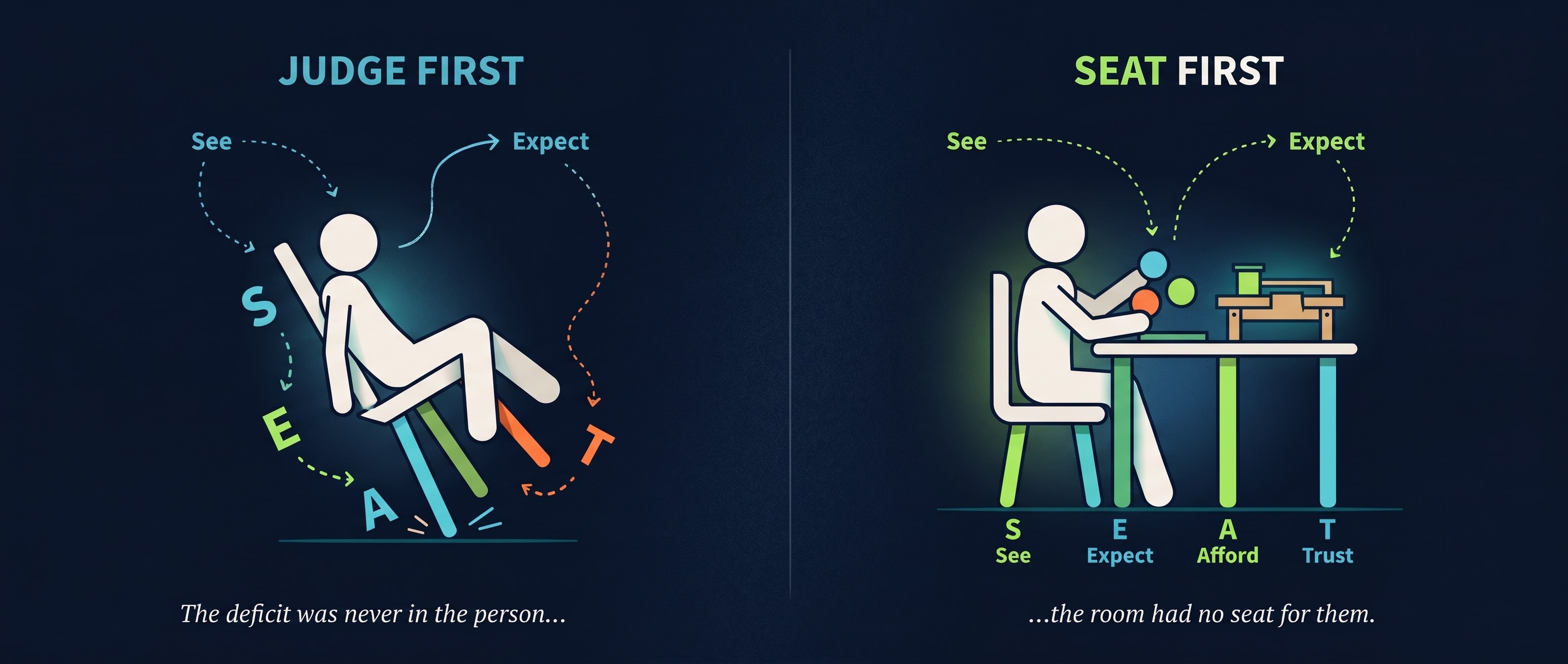
So SEAT treats the setting as the thing to be designed. It names four things a setting must do, and the four verbs spell the word:
See, Expect, Afford, Trust
The verb
What the room does
The question to ask of any setting
S
See
Notices the work before judging the person
Who was noticed, and on what basis?
E
Expect
Presumes competence; the institution carries the burden of proof
Whose account was taken as authoritative?
A
Afford
Puts what people need within reach, where they already are
What was within reach, and for whom?
T
Trust
Hands over something real that could fail, early, not as a reward
Who was trusted with something that could fail?
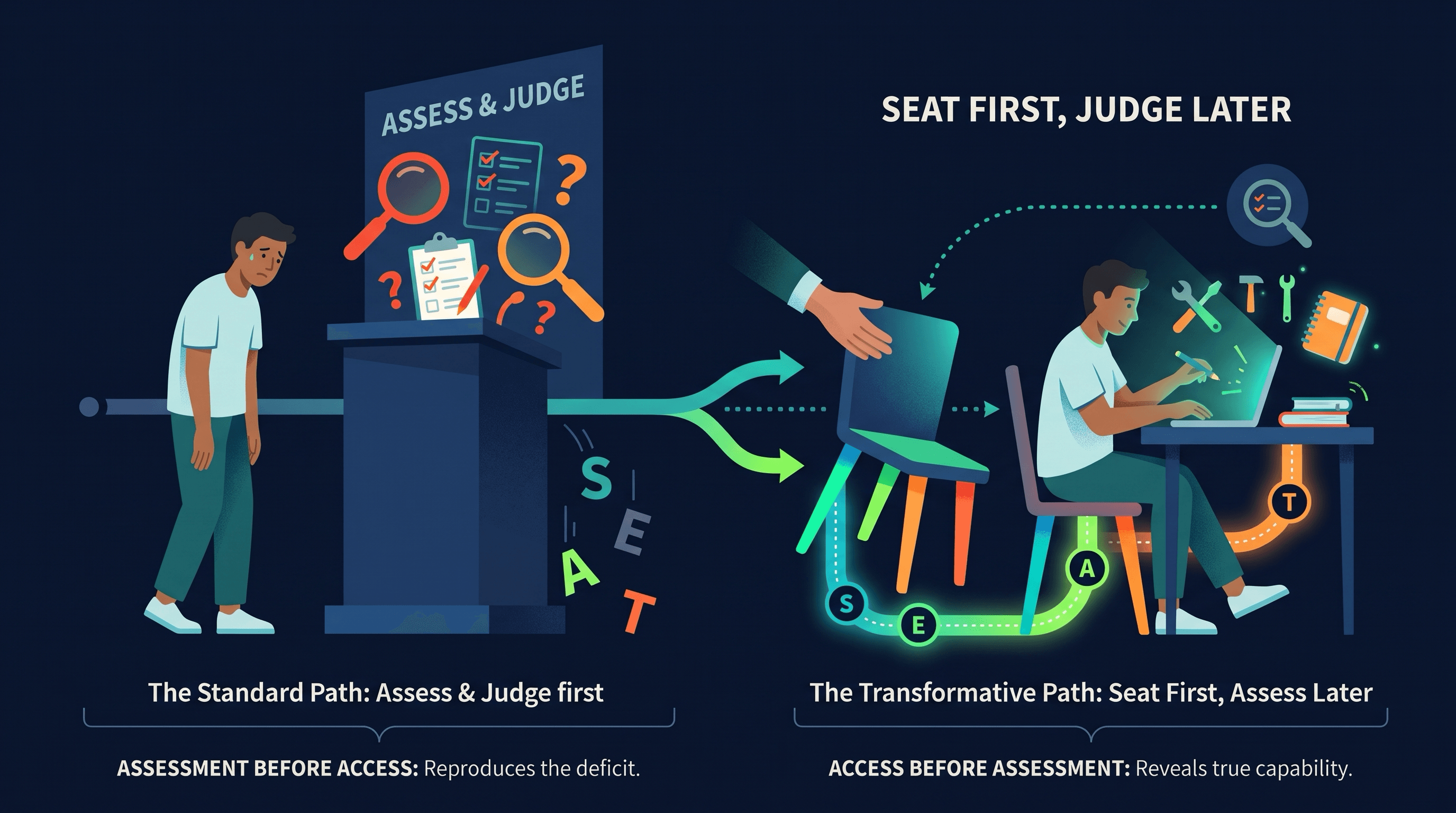
The governing rule: seat first, judge later.
Everyone who enters receives all four, before any assessment. Assessment measures what a person has already been allowed to do. A setting that assesses first reproduces every earlier decision about that person. A setting that seats first produces new evidence and can judge on that.
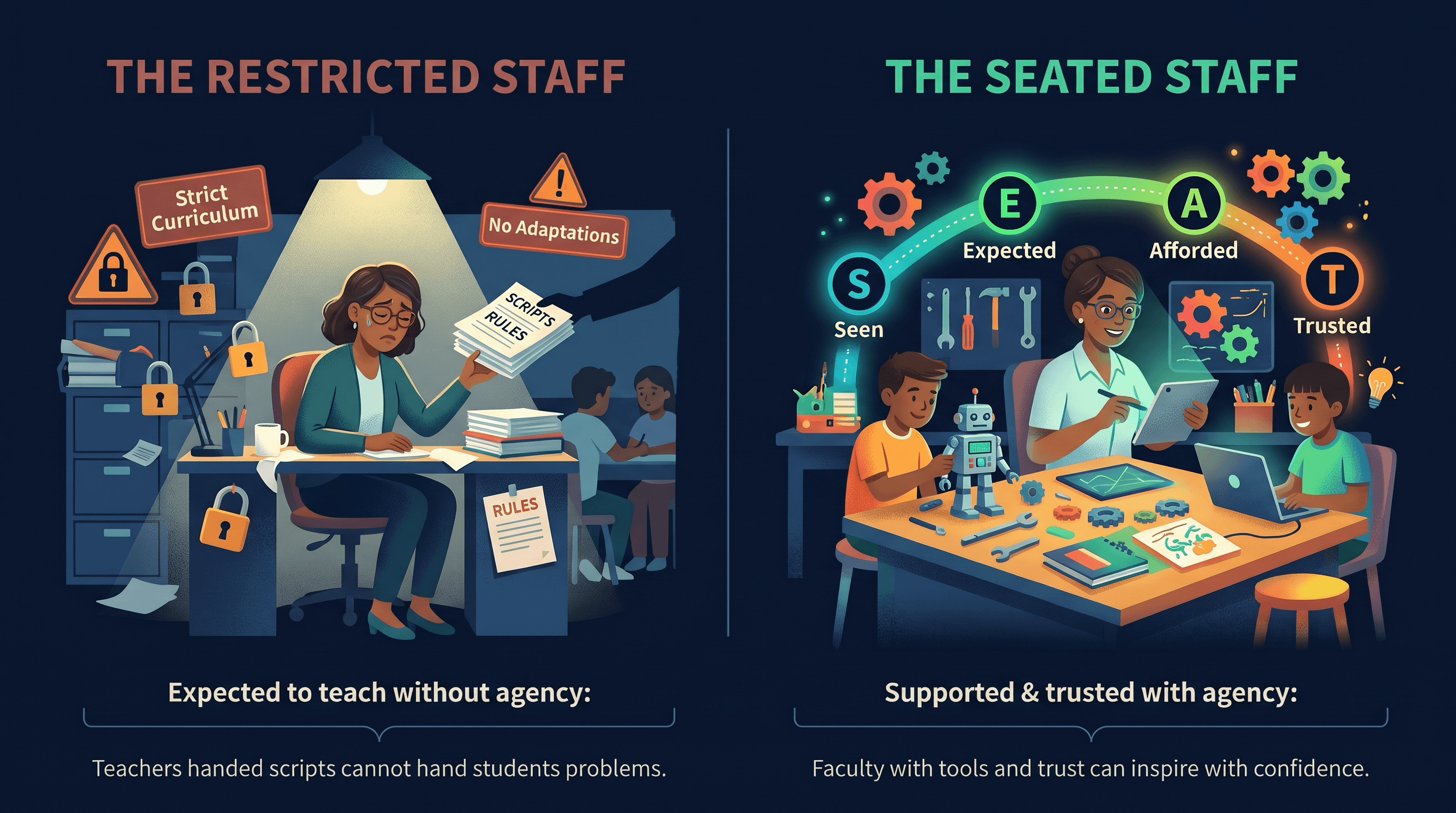
The corollary: seat the staff.
The four verbs apply to the people who run a setting as much as to the people it serves. Teachers handed scripts will not hand students problems. Faculty treated as behind on technology will not hand students new tools with confidence.
The name is also the claim. Every room owes every person a seat. The deficit was never in the person; the room had no seat for them.
The four verbs
The four verbs
S
See
Notice the work, not the person.
Attention that attaches to a person is filtered by every assumption the observer already holds. Attention that attaches to what someone made is not: a finished object, a solved problem, a repaired machine, a plan that worked does not know who made it. The person receives the recognition anyway, which is the point.
Seeing also means looking before judging. Put real materials in front of everyone and watch what they do, so that the record, not the assumption, does the noticing.
In practice: the iMAKE Center displays student-created work throughout the space, advertises student opportunities to everyone, and publicly recognizes students for desirable behavior. In the external evaluation's equity walk-through, publicly recognizing students was not observed at the first visit and was observed at the second.
E
Expect
Remove the answer key.
Respect becomes structural when the authority in the room cannot consult a solution. A problem with no known answer forces the instructor, manager, clinician, or caregiver to evaluate the other person's proposal on its merits. Competence stops being something the authority must choose to presume and becomes the only way the work can proceed.
Expecting competence also moves the burden of proof. Inclusion is the default; exclusion is what has to be justified.
In practice: iMAKE's stated culture is that students are invited to touch, explore, build, fail safely, repair, redesign, collaborate, and lead. The evaluation found positive rapport between students and adults at both observations, and interviewees across all four groups (students, staff, faculty, administrators) described hands-on, project-based work as the reason students stayed.
A
Afford
Move the resources, not the people.
The verb is chosen on purpose. An affordance is what an environment offers the person in it, and a resource affords nothing unless it is within reach. Resources that must be traveled to, applied for, or known about in advance are allocated by who can travel, apply, and know. Resources placed where people already are remove that filter.
The question is never whether a person is "ready" for the resource. It is whether the resource has been put within reach.
In practice: broadband installed by hand in Englewood; Code & Conquer delivered at three community partner sites in South LA; a community college makerspace with equipment beyond what the ASEE review found at top-100 engineering universities; mobile makerspace outreach to schools, reported by every interview group in the evaluation.
T
Trust
Hand over responsibility first.
Responsibility is normally the last thing delivered, after a person has proven worthy by the institution's own measures. For the people those measures were not built for, that day never comes. Trust delivered first changes what a person believes they are for, and later setbacks have a harder time overwriting it.
In practice: iMAKE runs a student employee team. Thirteen of its members were interviewed in the evaluation's final phase. They are not observers of the center; they staff it, repair its equipment, and train other students. Responsibility for something that can break, and for fixing it, is handed over early.
The deficit was never in the person; the room had no seat for them.
The SEAT Framework
Where it comes from
Where it comes from
SEAT was not derived from a literature. It was assembled, over years, from things that kept working and things that kept failing, in rooms I built or ran:
A kitchen table in New York. Two brothers and a younger brother, no adult most afternoons, and algebra that got broken into its smallest parts and rebuilt together until it made sense. Education as investigation, not obligation, and the first time I was handed real responsibility for someone else's learning.
A decade of summer coding camps in Illinois, run in partnership with Northwestern University, with sessions on music and code, sports analytics, crafts and robotics, art and animation, and game design. Kids built before anyone assessed them.
Broadband on Chicago's South Side. I climbed a roof to install a wireless bridge and hand-installed access points in a utility closet for a community development corporation in Englewood, then founded the Greater Englewood Chamber of Commerce around the same idea: the infrastructure has to go to the neighborhood, not the neighborhood to the infrastructure.
Code & Conquer in South Los Angeles, delivering hands-on technology and workforce training across three community sites (Shields for Families, New Designs Charter School in Compton, and the Crenshaw YMCA).
The iMAKE Makerspace at Moreno Valley College, a Hispanic-Serving Institution, where the pattern became clear enough to name and test.
Early-childhood classroom experiments, ages three to five, now underway as part of a K-16 data-literacy pipeline with the Moreno Valley school district.
Across these rooms, the same four moves kept separating the rooms that worked from the ones that didn't.
SEAT across the pipeline
SEAT across the pipeline
The four verbs apply wherever a person is trying to move through a system. These are the settings where I have worked, and what each verb looks like there.
See, Expect, Afford, and Trust in the settings where the work has been done.
Setting
See
Expect
Afford
Trust
Early childhood (3–5)
Put real materials in front of every child and watch; recognize the object, not the child
"You can touch everything you see in here" is the rule, not the exception
Bring the makerspace to the classroom (mobile outreach)
Give each child a task that can go wrong and is theirs to finish
K-12
Pair screening with observation of children working with real materials
Make inclusion the default at each gate; exclusion must be justified
Place labs and programs in schools and community sites, not behind application
Every student is responsible for a build or experiment that could fail
Community college
Display and credit student work; recognize it publicly
Open problems with no answer key; faculty cannot hand down solutions
Equipment, mentors, and career links on campus; outreach off campus
Student employees staff the center, repair equipment, train peers
Faculty and staff
Treat faculty expertise as the starting point of training
Present the tool as one faculty direct, not a verdict on whether they are behind
Bring training to the department and the retreat, not a distant course
Put faculty in charge of redesigning their own curriculum
Neighborhood and community
Count what a community already builds
Take local knowledge as authoritative about local need
Infrastructure installed where people live (broadband, training sites)
Community organizations own and run the program locally
Early childhood (3–5)
See
Put real materials in front of every child and watch; recognize the object, not the child
Expect
"You can touch everything you see in here" is the rule, not the exception
Afford
Bring the makerspace to the classroom (mobile outreach)
Trust
Give each child a task that can go wrong and is theirs to finish
K-12
See
Pair screening with observation of children working with real materials
Expect
Make inclusion the default at each gate; exclusion must be justified
Afford
Place labs and programs in schools and community sites, not behind application
Trust
Every student is responsible for a build or experiment that could fail
Community college
See
Display and credit student work; recognize it publicly
Expect
Open problems with no answer key; faculty cannot hand down solutions
Afford
Equipment, mentors, and career links on campus; outreach off campus
Trust
Student employees staff the center, repair equipment, train peers
Faculty and staff
See
Treat faculty expertise as the starting point of training
Expect
Present the tool as one faculty direct, not a verdict on whether they are behind
Afford
Bring training to the department and the retreat, not a distant course
Trust
Put faculty in charge of redesigning their own curriculum
Neighborhood and community
See
Count what a community already builds
Expect
Take local knowledge as authoritative about local need
Afford
Infrastructure installed where people live (broadband, training sites)
Trust
Community organizations own and run the program locally
Faculty and staff is a direct application of the corollary, and it is why the community-college training belongs in this framework and not beside it.
The SEAT Audit
The SEAT Audit
Any setting can be audited, by anyone, with four questions. Record the answers at the level of the single interaction, not the program description, because policies say what a room intends and interactions show what it does.
See
Who was noticed, and on what basis?
Whose work was looked at, and whose was not?
Expect
Whose account was treated as authoritative?
Who was presumed capable, and who had to prove it first?
Afford
What was within reach, and for whom?
What had to be traveled to, applied for, or known about in advance?
Trust
Who was handed something that could fail?
Who was permitted only to watch?
Then ask the governing question of the whole setting: did it seat first, or judge first?
The audit does not depend on who the person is. It asks only what the room did. This makes it usable in a classroom, a clinic, a workplace, or a program, and by the people inside it.
Related, not the same: the iMAKE STEM Equity Framework (Layne & Coleman) describes how experiential learning and makerspace elements produce a diversified STEM education-to-career pathway. SEAT is the layer underneath: the four things the environment must do for any of that to reach the people it is meant for.
What to test next
What to test next
A framework you cannot test is a belief. Three studies follow directly, using partners and sites already in place.
Isolate the verbs.
Compare iMAKE courses and spaces that deliver all four with comparable ones that deliver some, using the SEAT Audit as the instrument alongside existing retention and completion data. This tests whether the verbs are the active ingredients.
Follow people across rooms.
Track the same students across settings (classroom, makerspace, workplace, community program) and test the central claim directly: that a person's trajectory depends on which room they are in. This is the study that would move SEAT from a framework to a finding.
Test it early.
Evaluate the ages three to five classroom experiments with the Moreno Valley school district, comparing children given real responsibility early with children who are supported but only watch.
Using SEAT
Using SEAT
Design a room:
start with the four questions above. For each one, write what your setting actually does, then what it would do if it seated first.
Audit a program:
record ten interactions and answer the four questions for each. The pattern is usually visible by the fifth.
Train staff first:
if the people running the room are not seen, expected, afforded, and trusted, they will not be able to deliver it.
Speaking & collaboration
To bring SEAT to a school, college, workforce program, or community organization, or to pilot the audit in your setting, get in touch.